
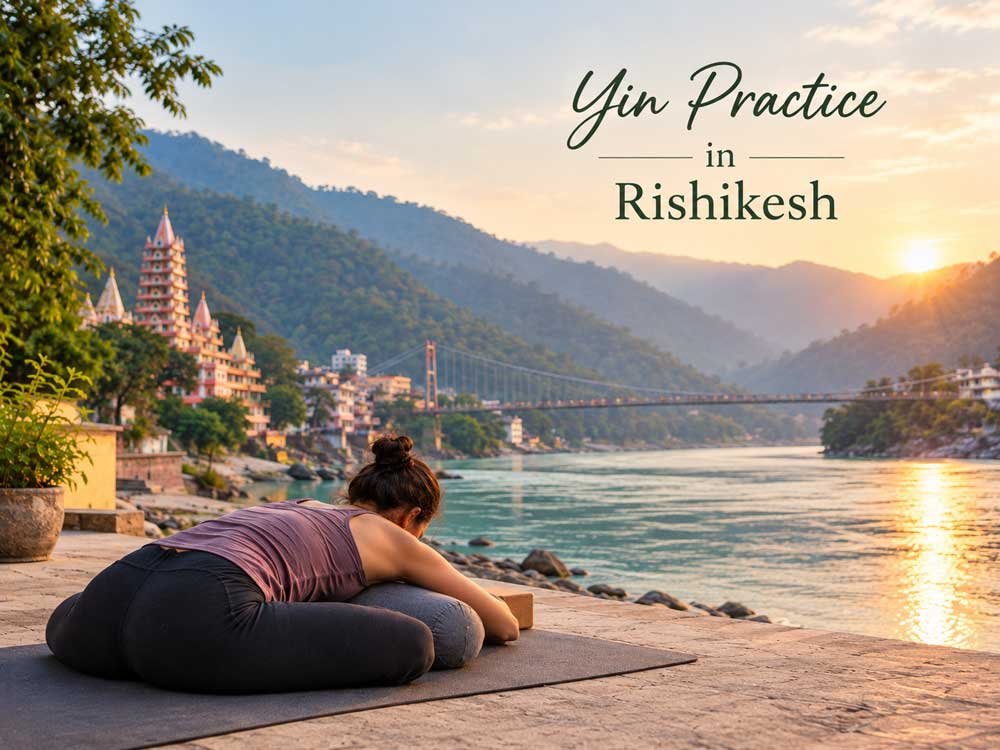
Anyone who comes to Rishikesh expecting silence is in for a surprise. Temple bells start before it is light, scooters squeeze past cows in lanes that were never built for either, and somebody is always selling chai. Underneath all of it the Ganga keeps up its steady roar: green and bitingly cold for most of the year, a fast, muddy brown during the monsoon.
I have lived beside that noise for years, and I have watched a great many people find a kind of stillness inside it. I see it most clearly in the students on our month-long Yin course, though rarely in their first week, and almost never in the way they imagined when they booked.
Three to five minutes in one shape
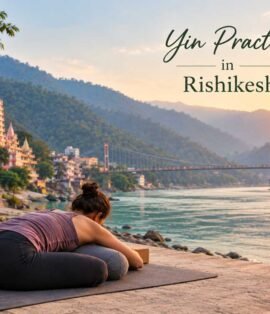
On paper, Yin looks like the easiest class on the timetable. Nearly everything happens on the floor. You fold forward over a bolster, lie back across a block or let your legs slide apart into a wide straddle, and then you stay there for three to five minutes while the props take the weight. After a while the muscles give up holding on, and the slower tissues around the joints, the fascia and ligaments, get the long, gentle load that a faster class never gives them.
Nobody asks you to go deeper, and there is no better version of the pose to work towards. The instruction, more or less, is to stay where you are and notice what happens.
That turns out to be surprisingly hard, and flexibility has very little to do with it. In the first week most minds go everywhere except the mat: what’s for lunch, a conversation from three years ago, whether the phone has signal yet. Three minutes is a long time when you are used to filling every one of them, and for most people the difficult part is not the stretch at all but simply staying put.
What the day looks like
The routine of the ashram does a lot of the work here, and our timetable barely changes from one day to the next. The first class starts at half past six, pranayama and cleansing practices follow, and breakfast is at a quarter past nine. After that comes an hour of karma yoga, which in practice means helping to keep the place running. Anatomy and philosophy take up the rest of the morning; the afternoon is for lunch, rest, the library and your own practice; then meditation and the evening class carry you through to dinner at about a quarter past seven. Most people are asleep not long after.
For the first few days the sameness can feel odd. Meals come from a fixed menu, the timetable decides when you get up, and there are very few choices left to make. Somewhere in the second or third week that stops feeling like a set of rules and starts to feel more like being looked after, and the attention that used to go on small decisions has to go somewhere else.
Usually it goes to small things: the light on the hills across the river late in the afternoon, or how different your hips feel in the hall at half past six on a January morning, when it can be five degrees outside, compared with a mild one in April. Most people also notice which thought keeps coming back every time they lie still, and how much quieter it has become by the last week.
Meridians and the five elements
Yin as it’s taught now has two parents. The postures and the attention to breath come from Hatha yoga. The theory comes from Taoist thought and Chinese medicine: a map of meridians, the channels along which energy is said to flow, and the five elements of Earth, Water, Fire, Wood and Metal.
You don’t have to believe every part of that map to find it useful. Holding a long hip opener is easier when you have something to think about besides the ache, and knowing that the pose is meant to work on the Liver and Gall Bladder meridians is a good deal more interesting than counting breaths. Matching a season to an element works the same way. Used like that, as somewhere to rest the mind during a long hold, the theory earns its place even for sceptics.
A few schools now teach Yin as a complete training rather than as the quiet ten minutes at the end of a stronger class, and we are one of them. Our Yin Yoga teacher training at Sri Yoga Ashram runs for 25 days near Laxman Jhula, with the twelve meridians, the five elements and Yoga Nidra, the guided practice of deep rest, studied alongside the long holds. Having four weeks matters more than it might seem, because the theory sinks in slowly, much as the poses do.
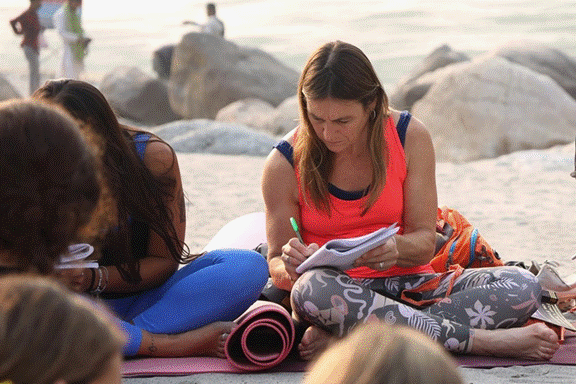
Students taking notes during an outdoor class on the sandy bank of the Ganga.
Image: Sri Yoga Ashram
Laxman Jhula and the river
The ashram sits behind the police station at Laxman Jhula, with a small stream running past the building, and the moment you step out of the gate Rishikesh comes rushing back. The lanes down to the river are lined with cafés whose balconies hang over the water, shops selling malas and singing bowls, and monkeys who will happily take a banana out of your hand if you look the other way. Sadhus in saffron sit on the ghat steps, and temples climb the hillside above the river.
The Ganga is the centre of all of it. This close to the hills it moves fast, and outside the monsoon it runs clear enough to show the stones on the bottom. Sit on the rocks at the edge for a few minutes and you can feel the cold coming off it even on a hot afternoon.
After a few weeks of long holds, people start to look at the river differently. It never stops moving, yet it never seems to be in a hurry, and it goes around the boulders instead of pushing against them. Pilgrims have been coming to this stretch of water for centuries to think and pray, and after an afternoon of Yin it’s easy to see why. It is one of the best places I know to sit after a long practice.
Aarti at dusk
As the sun goes down, people gather on the ghats for Ganga Aarti, the evening offering to the river. Young priests in red lift heavy brass lamps and swing them in slow circles while the bells ring and everyone sings. Little boats made of leaves, each holding a few marigolds and a lit wick, are set down on the current and carried off into the dark.
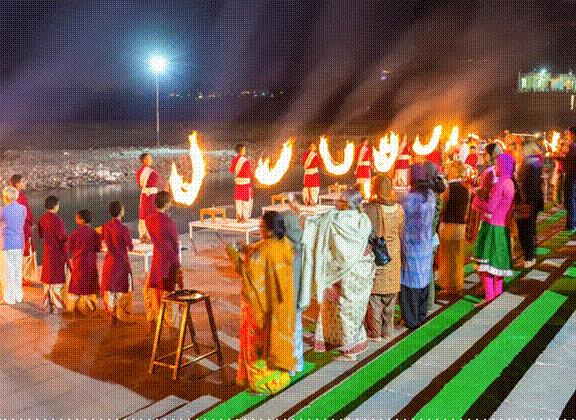
Ganga Aarti on the ghats in Rishikesh at dusk.
Image: Sri Yoga Ashram
In most respects aarti is the opposite of a Yin class. It is loud and bright, and you share it with hundreds of strangers. Yet what it asks of you is oddly similar: you watch the flames, and for a few minutes you aren’t planning anything at all.
Aarti is one of our Sunday outings, and for many students it becomes the way they close the week. A quiet hall is a forgiving place to learn to settle. The ghats, with the crowd, the smoke and the singing, are where you find out whether the settling holds.
Sundays: caves and a sunrise temple
Sunday is the day off, and the hills around Rishikesh make good use of it. About an hour upstream by road is Vasishtha Cave, linked by tradition to the sage Vasishtha; it is cool and dim inside, and people sit there without speaking. Close by is the smaller Arundhati Cave, named after Vasishtha’s wife, which is usually quieter still.
Kunjapuri Temple lies the other way, on a ridge near Narendra Nagar, roughly an hour’s drive from Rishikesh followed by a short climb of steps. You set off in the dark to be there for sunrise, when the light comes up over the Garhwal hills.
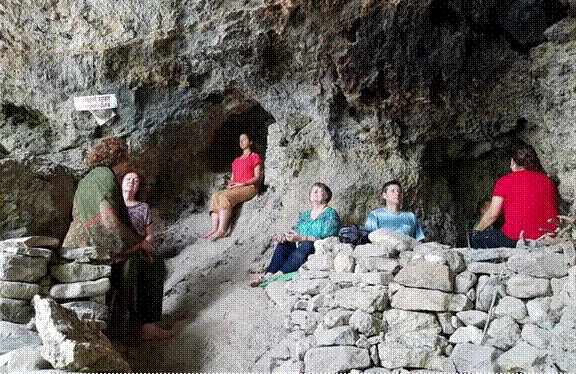
Students meditating in Arundhati Cave, next to Vasishtha Cave, on a Sunday trip.
Image: Sri Yoga Ashram
Neither place has anything to entertain you. The cave is just a cave, and the sun comes up when it comes up. You sit and let the time pass, which by the third week is something most of our students have become rather good at.
What students take home
The answers, when people try to put the month into words, are usually modest. A sensation that feels like too much in the first minute of a hold is often far milder by the third, and a lot of discomfort outside the yoga hall turns out to behave the same way. Resting properly is a skill: Yoga Nidra and supported poses show most of us how seldom we really let go, and how much better we feel once we do. A steady routine, oddly, leaves more room for attention. And the river, which never stops and never rushes, is a good picture of being calm without being frozen.
None of this is new. It is all in the old texts, and teachers everywhere say it in one form or another. Reading it and feeling it settle into your hips on a cold morning beside the Ganga are two quite different things, though.
When people go home, ordinary life comes back fast: email, traffic, deadlines. What seems to stay with many of them is a small habit of pausing. They take a few breaths before answering a message, stay a minute longer in a stretch and are a little more willing to wait and see what happens next.
It’s a small thing to carry home from India. In my experience it outlasts the flexibility by a long way.
About the Author
Dr Gaurav Agrawal founded Sri Yoga Ashram, near the Post Office at Laxman Jhula in Rishikesh, in 2016. He lives on the premises with his family, so he spends most of his days around the students, and he has taught yoga philosophy since 2012. He holds a PhD in clinical psychology.



Comments are closed