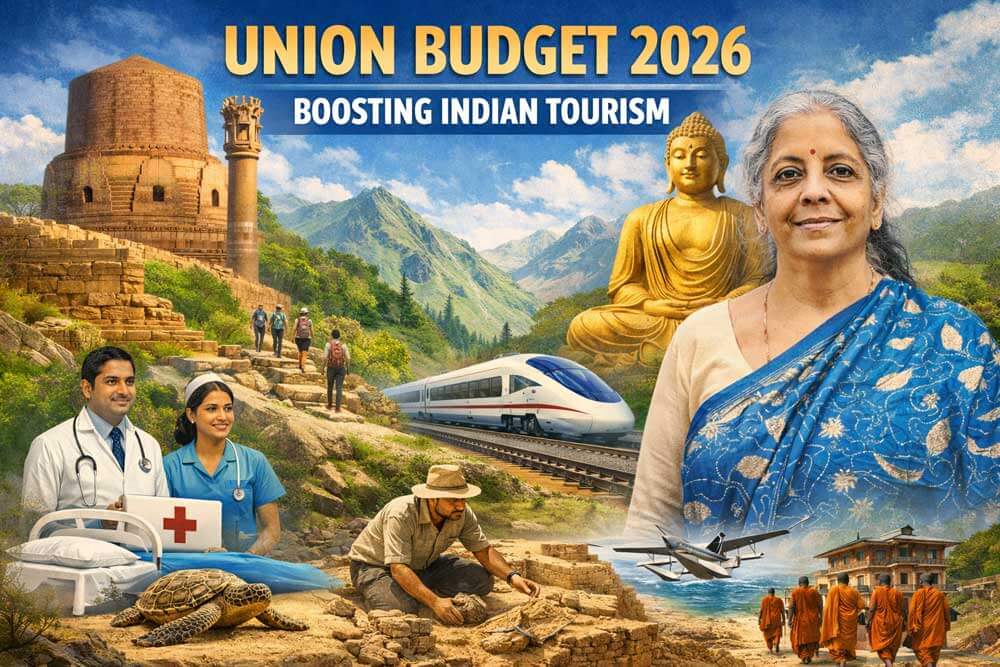
Tourism has steadily emerged as one of India’s most powerful engines of economic growth, cultural preservation, and employment generation. In the Union Budget 2026–27, Finance Minister Nirmala Sitharaman formally acknowledged this potential by placing tourism at the heart of India’s long-term development strategy.
Instead of focusing exclusively on promotion or infrastructure, Budget 2026 adopts a comprehensive, experience-oriented approach that integrates tourism with skill development, heritage conservation, ecological sustainability, connectivity, and healthcare.
This article provides a fact-checked overview of how the Union Budget 2026 strengthens Indian tourism and its implications for travelers, pilgrimage circuits, heritage destinations, and local communities across India.
Tourism in Union Budget 2026: A Strategic National Priority
In her Budget speech, the Finance Minister highlighted tourism’s ability to:
- Generate large-scale employment
- Support local and rural economies.
- Promote India’s cultural and civilisational heritage.
- Strengthen India’s global soft power.
In contrast to previous years, Budget 2026 positions tourism not as an isolated sector but as a strategic link among culture, the economy, sustainability, and regional development.
Strengthening Hospitality & Tourism Skills
National Institute of Hospitality
One of the most significant announcements is the upgradation of the National Council for Hotel Management and Catering Technology into a National Institute of Hospitality.
Purpose:
- Improve the global competitiveness of Indian hospitality education.
- Enhance industry-academia collaboration
- Create a skilled workforce aligned with international standards.
This initiative directly addresses the persistent skills gap within India’s hospitality and tourism sector.
Training 10,000 Tourist Guides
The Budget introduces a pilot programme to train 10,000 tourist guides across identified destinations.
Key focus areas include:
- Cultural interpretation and storytelling
- Visitor safety and ethics
- Communication and language skills
- Sustainable tourism practices
For travelers, this initiative ensures more meaningful and informed experiences. For local youth, it generates dignified, location-specific employment opportunities.
Eco-Tourism and Experience-Based Travel
Recognizing the shift in traveler preferences, Budget 2026 places significant emphasis on experience-driven and environmentally responsible tourism.
Sustainable Tourism Trails
The government announced the development of:
- Mountain and trekking trails in the Himalayan regions
- Nature trails in biodiversity-rich landscapes
- Conservation-linked trails, including turtle nesting zones
These initiatives aim to:
- Promote low-impact tourism
- Encourage longer stays
- Reduce pressure on overcrowded destinations.
This strategy aligns with India’s commitment to responsible tourism and ecological sustainability.
Heritage Tourism: From Monuments to Experiences
India’s archaeological heritage is central to its tourism identity. Budget 2026 proposes the development of 15 archaeological sites as experiential cultural destinations.
What This Means
- Curated public access to excavated sites
- Interpretive walkways and visitor infrastructure
- Improved storytelling and educational engagement
Confirmed sites include:
- Dholavira
- Lothal
- Rakhigarhi
- Sarnath
- Hastinapur
- Adichanallur
- Leh Palace
This initiative shifts heritage tourism from passive sightseeing to immersive cultural learning, benefiting both visitors and local communities.
Buddhist Circuit Development: Strengthening Pilgrimage Tourism
Pilgrimage tourism remains a cornerstone of Indian travel. Budget 2026 introduces a dedicated scheme for the development of Buddhist Circuits, with special emphasis on the Northeastern states.
Key Objectives
- Improve connectivity to Buddhist heritage sites.
- Upgrade pilgrim amenities
- Enhance interpretation and visitor facilities.
This initiative has strong potential to attract:
- Domestic pilgrims
- International Buddhist travellers
- Cultural tourists from East and Southeast Asia
It also supports regional development in historically under-visited areas.
Medical Tourism: Expanding India’s Global Healthcare Appeal
India’s status as a medical tourism destination is further reinforced by the announcement of Regional Medical Value Tourism Hubs.
What the Hubs Will Integrate
- Advanced medical treatment
- AYUSH and wellness services
- Hospitality and post-treatment care
Medical tourism represents a high-value segment that generates foreign exchange and creates employment across healthcare, hospitality, and transport sectors.
Connectivity & Travel Affordability
Reduced TCS on Overseas Tour Packages
The Budget reduces the Tax Collected at Source (TCS) on international tour packages to a flat 2 percent, thereby easing financial pressure on travelers and improving cash flow for travel businesses.
Infrastructure Supporting Tourism
While not tourism-exclusive, the Budget announces:
- Seven high-speed rail corridors
- Support for regional air and seaplane connectivity
These investments indirectly enhance tourism by improving access to emerging destinations.
What Has Been Deliberately Excluded
To ensure factual accuracy, the following were not included due to a lack of consistent official confirmation:
- Exact number of tourism hubs in Purvodaya states
- Specific figures related to e-bus deployment
- Any unverified budget allocation increases.
This approach ensures that the article remains credible, authoritative, and suitable for publication.
Why Union Budget 2026 Matters for Indian Tourism
The Union Budget 2026 signifies a structural shift in India’s approach to tourism.
Long-Term Impacts Include:
- Better-trained tourism workforce
- Diversification into eco, heritage, pilgrimage, and medical tourism
- Reduced pressure on overcrowded destinations
- Increased participation of local communities
- Stronger global positioning of India as a holistic travel destination
Conclusion: A Measured but Meaningful Tourism Vision
Union Budget 2026 avoids grand promises or headline-driven allocations. Instead, it establishes a measured, experience-focused foundation for sustainable tourism growth in India.
By integrating skill development, heritage conservation, ecological responsibility, and connectivity, the Budget positions tourism as a long-term national asset rather than a seasonal industry.
If implementation aligns with intent, India’s tourism sector in the coming decade will become deeper, more inclusive, and more authentic, reflecting the true spirit of the nation.
FAQs
Union Budget 2026 positions tourism as a strategic growth sector, focusing on skill development, heritage destinations, eco-tourism, Buddhist circuits, medical tourism hubs, and improved connectivity.
The Budget benefits Indian tourism through trained tourist guides, upgraded hospitality education, experiential heritage sites, sustainable tourism trails, and improved pilgrimage and medical tourism infrastructure.
Key highlights include the National Institute of Hospitality, training of 10,000 tourist guides, development of 15 archaeological sites, Buddhist Circuit expansion, eco-tourism trails, and medical tourism hubs.
Budget 2026 focuses on experiential development of archaeological sites and enhanced Buddhist pilgrimage circuits, improving visitor facilities, storytelling, and regional tourism growth.
Union Budget 2026 is important because it shifts tourism from promotion-led growth to experience-led, sustainable, and employment-focused development, strengthening India’s global tourism competitiveness.